
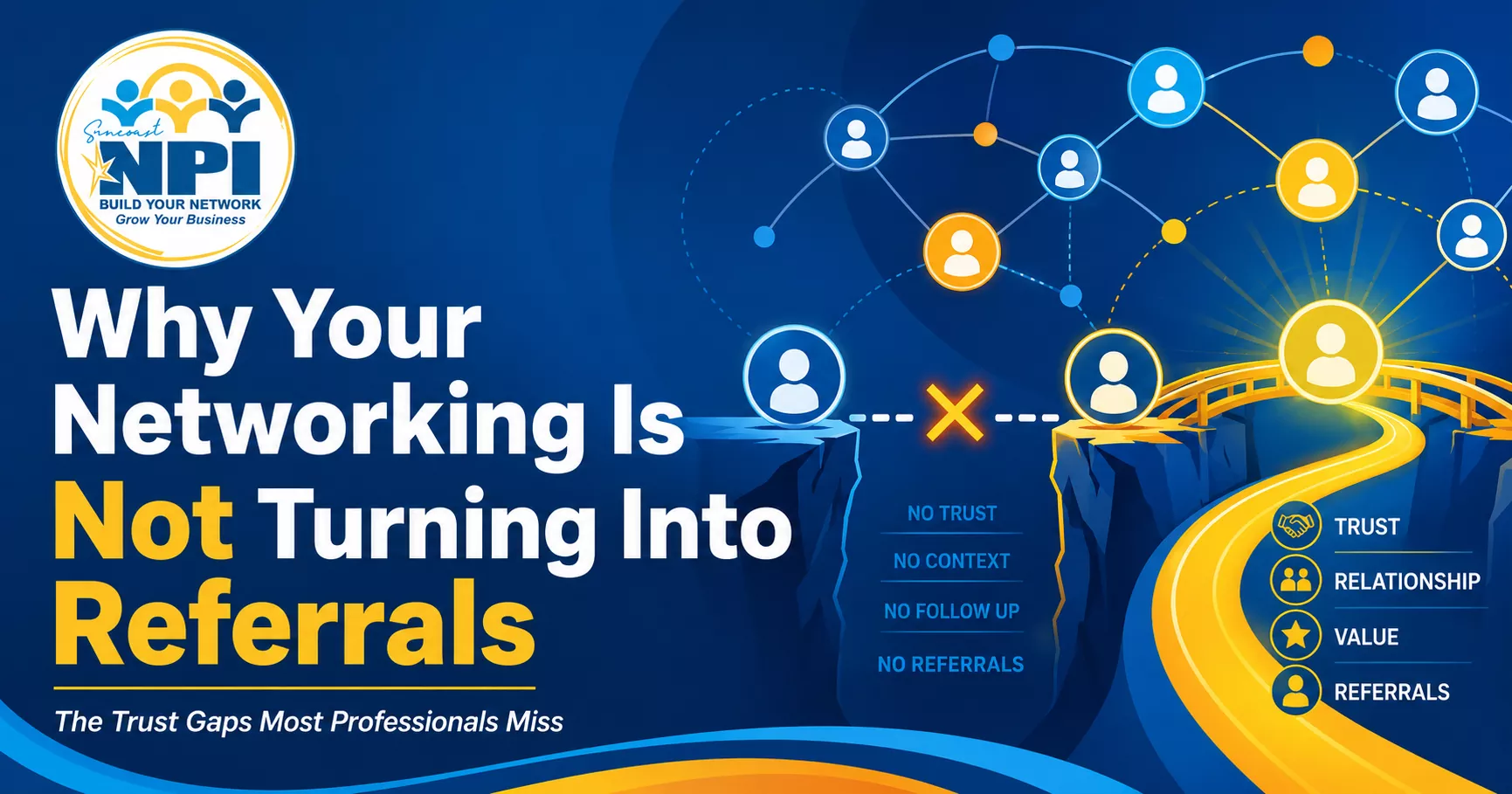
Referrals Are Built on Trust, Not Just Visibility
Showing up matters, but referrals require more than being seen. If your networking is not turning into real introductions, the issue may not be effort. It may be clarity, consistency, follow-through, or trust.
Why is my networking not turning into referrals?
Networking does not turn into referrals when people know what you do but do not yet trust you enough to introduce you to someone who matters to them. Referrals require more than visibility. They require clarity, consistency, credibility, follow-through, and real relationship-building over time.
Most professionals do not have a networking problem.
They have a trust problem.
That may sound harsh, but it is usually true.
They are showing up. They are introducing themselves. They are attending meetings, exchanging cards, making small talk, and telling people what they do.
But the referrals are not coming.
Or they come slowly.
Or they come from the same two people.
Or they come only after months of wondering whether the time spent networking is actually doing anything.
When that happens, most people assume they need to meet more people.
They think they need a better commercial, a stronger pitch, a bigger room, a different group, or more exposure.
Sometimes that helps.
But more often, the issue is not visibility.
The issue is trust.
Because people do not refer you just because they know your name.
They refer you when they trust what happens after they make the introduction.
Referrals Are Not Casual Recommendations
A referral is not just someone saying, “You should call this person.”
A real referral carries weight.
When someone refers you, they are putting their own reputation into the conversation.
I trust this person.
I believe they can help you.
I am comfortable connecting my name to their work.
That is a much bigger decision than most people realize.
This is why people may like you, enjoy talking with you, and still not refer you.
Liking someone is easy.
Trusting them with a client, friend, family member, or professional contact is different.
That is where many networking relationships stall.
The First Trust Gap: People Do Not Clearly Understand What You Do
This one seems basic, but it is one of the biggest referral blockers.
People cannot refer what they cannot clearly explain.
If your description of your work is too broad, too vague, too technical, or too similar to everyone else in your industry, people may remember you as “the insurance person,” “the marketing person,” “the realtor,” “the attorney,” or “the wellness person.”
That is not enough.
A strong referral usually needs more clarity than that.
People need to understand:
- Who you help
- What problem you solve
- What signs tell them someone needs you
- What makes you different
- What kind of introduction is actually helpful
If people have to work too hard to explain you, they probably will not refer you.
Not because they do not care.
Because they do not want to get it wrong.
The Second Trust Gap: They Know Your Title, But Not Your Value
There is a big difference between knowing someone’s profession and understanding their value.
People may know you are a mortgage lender, but do they know what kind of buyer you are best at helping?
They may know you own a cleaning company, but do they understand what makes your service safer, more reliable, or easier for busy families?
They may know you do bookkeeping, but do they know the moments when a business owner should call you before things get messy?
They may know you are a realtor, but do they know whether you specialize in first-time buyers, downsizing seniors, investment properties, relocation, or luxury homes?
A title gives people a category.
Value gives people a reason to remember you.
If your networking message stops at your job title, people may know where to place you, but not when to refer you.
The Third Trust Gap: You Are Trying to Be Remembered by Everyone
This sounds like a good goal.
It usually is not.
When professionals try to make their message appeal to everyone, they often become harder to refer.
The more general your message is, the less memorable it becomes.
Too General
“I help anyone who needs insurance.”
“I work with buyers and sellers.”
“I can help any business with marketing.”
More Referable
“I help business owners whose websites no longer explain what they actually do.”
“I help homeowners prepare a house for sale without feeling overwhelmed.”
“I help people turning 65 understand their Medicare options.”
General statements may be true, but they do not give people a clear referral trigger.
A referral trigger is the moment someone hears a need and immediately thinks of you.
For example:
Those are referral moments.
If people do not know what specific problem should make them think of you, they may not think of you at all.
The Fourth Trust Gap: You Are Visible, But Not Consistent
Showing up once creates awareness.
Showing up consistently creates trust.
This is where many people get frustrated with networking. They attend a few meetings, have a few conversations, and expect the referrals to start.
But most people need time before they are comfortable referring.
They need to see how you show up.
Consistency answers questions your commercial cannot:
- Do you attend consistently?
- Do you follow through?
- Do you listen?
- Do you support other members?
- Do you stay connected when you do not need anything?
- Do you act the same way when you are not the center of the conversation?
Over time, people start to see patterns.
And patterns build trust.
The Fifth Trust Gap: You Talk About Yourself More Than You Build Relationships
Networking gives you a chance to talk about your business.
But that is not the same as building relationships.
Some professionals use every interaction as a chance to explain what they do, promote an offer, hand out information, or move toward a sale.
They may not mean to come across as transactional.
But people can feel it.
If every conversation feels like a pitch, people start protecting themselves from the relationship.
They may be polite.
They may smile.
They may even say, “That sounds great.”
But they are not leaning in.
The irony is that when you stop trying to force referrals, you often become more referable.
Relationship-based networking requires a different posture.
It sounds more like curiosity, generosity, and attention.
Better relationship-building questions:
- Tell me more about what you are working on.
- What kind of clients are you best at helping?
- What would be a good introduction for you?
- What should I listen for?
- How can I support you?
- Who would be a good person for you to meet?
The Sixth Trust Gap: People Are Not Sure What Will Happen After They Refer You
This is huge.
Before someone refers you, they are often asking silent questions.
They may be wondering:
- Will you follow up professionally?
- Will you make me look good?
- Will you pressure the person I send you?
- Will you communicate clearly?
- Will you handle the situation with care?
- Will you let me know what happened?
- Will the person I referred feel helped, respected, and not sold to?
If people are unsure about the answer, they may hold back.
This is why how you handle small interactions matters.
Every follow-up, every thank-you, every conversation, every email, every missed detail, and every kept promise teaches people what it might feel like to refer you.
Your referral reputation is built long before the referral happens.
The Seventh Trust Gap: You Have Not Made It Easy to Refer You
People are busy.
Even people who like you may not remember exactly what you need.
If you want more referrals, make it easier for people to recognize and make the right introduction.
Less Helpful
“Let me know if you know anyone who needs my services.”
More Helpful
“A great introduction for me is a small business owner who has outgrown DIY marketing and knows their website is not clearly explaining what they do.”
Specificity helps people help you.
It gives them language.
It gives them confidence.
It gives them a reason to remember you at the right moment.
The Eighth Trust Gap: You Are Waiting for Referrals Instead of Creating Referral Confidence
There is a difference between asking for referrals and earning referral confidence.
Asking for referrals sounds like:
Who do you know who needs me?
Earning referral confidence sounds different.
It sounds like:
- Here is how I help.
- Here is who I am best for.
- Here is what happens when you introduce someone to me.
- Here is how I will take care of them.
- Here is what I need you to listen for.
- Here is how I will keep the process simple.
People want to feel safe when they refer.
The easier you make it for them to trust the process, the more likely they are to make the introduction.
The Ninth Trust Gap: You Are Not Referring Others
Referral relationships are not built by waiting.
They are built by participating.
If you want to be referred, become the kind of person who actively looks for ways to support other people.
That does not mean making random introductions just to look busy.
A bad referral is not helpful.
But it does mean paying attention.
Listen for needs.
Ask better questions.
Learn what other members do.
Understand who they help.
Look for real opportunities to connect people.
When you become someone who helps relationships move, people notice.
They see that you are invested in the group, not just your own outcome.
That matters.
The Tenth Trust Gap: You Disappear Between Meetings
A networking meeting can start a relationship.
It rarely builds the whole thing.
Relationships grow in the spaces between meetings.
That may mean a coffee conversation, a thoughtful follow-up, a quick check-in, a shared resource, a social media comment, an introduction, or simply remembering something someone told you.
You do not need to become everyone’s best friend.
But if the only time people see or hear from you is when you are standing up to promote your business, the relationship may stay thin.
Thin relationships create thin referrals.
Stronger relationships create stronger opportunities.
A Better Way to Think About Networking
Instead of asking, “Why am I not getting more referrals?” ask better questions.
Start here:
- Do people clearly understand what I do?
- Do they know who I am best at helping?
- Have I given them specific referral triggers?
- Have I shown up consistently enough to build trust?
- Have I made it easy to introduce me?
- Have I shown that I will take good care of the people they send me?
- Have I invested in others without keeping score?
Those questions will usually reveal where the referral gap really is.
The Referral Readiness Test
Here is a simple way to evaluate whether your networking is ready to produce stronger referrals.
Ask yourself:
- Can people explain what I do in one clear sentence?
- Can they name the type of person I help best?
- Can they recognize a problem that should make them think of me?
- Do they know what makes me different?
- Do they trust that I will follow up professionally?
- Do they believe I will make them look good if they refer me?
- Have I built enough relationship outside the room?
- Have I shown interest in helping others succeed?
If the answer is no to any of these, that is not a failure.
It is a place to strengthen.
Final Thoughts
Networking is not a vending machine.
You do not put in attendance and automatically receive referrals.
Networking is a trust-building process.
It takes clarity.
It takes consistency.
It takes curiosity.
It takes follow-through.
It takes real relationship.
The professionals who earn the most meaningful referrals are not always the loudest people in the room.
They are not always the best presenters.
They are not always the ones with the most polished pitch.
They are the people others trust enough to recommend.
And that trust is built one conversation, one action, and one relationship at a time.
If your networking is not turning into referrals yet, do not assume it is not working.
Look for the trust gaps.
Then close them.
That is where the real growth begins.
Build the Kind of Trust That Creates Better Referrals
Suncoast NPI is built for professionals who want networking to be more than a room full of business cards. Our chapters give local business owners and professionals a place to build trust, strengthen relationships, and create meaningful referrals through consistent connection.
If you are ready to become more intentional about how you show up, who you connect with, and how referrals are built, Suncoast NPI can help you find the right room.
Find a ChapterThe strongest referrals start with trust.
Frequently Asked Questions About Networking and Referrals
Why is my networking not turning into referrals?
Your networking may not be turning into referrals because people know what you do but do not yet trust you enough to introduce you to someone important. Referrals require clarity, consistency, follow-through, and confidence in how you will handle the introduction.
How long does it take to get referrals from networking?
Referrals can happen quickly, but strong referral relationships usually take time. People need to understand what you do, see how you show up, trust your follow-through, and feel confident that you will take care of the people they introduce to you.
What makes someone referable?
A referable professional is clear about who they help, consistent in how they show up, trustworthy in their follow-through, easy to explain, and focused on relationships instead of quick transactions.
What is a referral trigger?
A referral trigger is a specific problem, situation, or phrase that helps someone immediately recognize when another person may need your help. Clear referral triggers make it easier for people to remember and refer you.
How can I get more referrals from networking?
To get more referrals from networking, make your message clearer, show up consistently, build real relationships, ask better questions, follow through professionally, support other members, and make it easy for people to understand who you are best at helping.