Podcast
Hey everyone! Jon Marshall here, owner of Suncoast NPI. As our business community keeps growing across Hillsborough, Pasco, and Pinellas, I see new members come into chapters with great energy, great intentions, and a real desire to make connections. That excitement matters. It gets people started. But the members who build the strongest referral relationships understand something important: networking works best when it becomes a steady commitment, not a short burst of activity.
Building a business through referrals is a process. It takes time for fellow members to know who you are, what you do, how you serve, and how you handle the relationships they trust you with. When a member refers you to a friend, client, family member, or business contact, they are putting their own reputation beside your name. That is why consistency matters so much.
Showing up regularly is one of the first ways members learn they can count on you. When you are present in the room, engaged in the meeting, and active in conversations, people get to know your character as much as your business. They hear your weekly message. They watch how you interact with visitors. They see how you support other members. Over time, those small moments build confidence.
Consistency also shows up between meetings. It is scheduling the one-to-one, following up after a conversation, making the introduction you said you would make, and remembering a member when you hear a need in the community. These actions may seem small in the moment, but they tell the chapter something important: you honor relationships.
That is the heart of referral networking. The referral is valuable, but the relationship behind it is even more valuable. A strong chapter is built by members who understand that every introduction deserves care. When you follow up professionally, communicate well, and treat the referred relationship with respect, you strengthen trust with both the person referred and the member who opened the door.
Consistency also helps your chapter learn how to help you. If your message changes every week, members may struggle to recognize the right opportunity. When you are steady with your referral request, your ideal client, and the problems you solve, the room gets better at listening for you. They begin to remember the details. They can repeat your message with confidence. That is when your chapter becomes a more effective extension of your relationship network.
This does not mean you have to be perfect. Life happens. Business gets busy. Families need attention. What matters is that you stay connected, communicate well, and remain committed to the commitment you made to your chapter. A strong culture is built by members who keep showing up for one another in practical, dependable ways.
Over six months, a year, or five years, that dependability becomes part of your reputation. People begin to know what they can expect from you. They trust how you handle referrals. They believe in the way you serve your clients. They feel confident saying your name in rooms where you are not present.
Your growth comes from the relationships you invest in consistently. When you prioritize being dependable, engaged, and service-minded, you build the kind of trust that lasts far beyond a weekly meeting.
Until next time, this is Jon Marshall reminding you: when we pull together, we all win!
Podcast
Hey everyone! Jon Marshall here, owner of Suncoast NPI. When business owners look at their return on investment for marketing, their first instinct is to pull up a spreadsheet and compare the cost of their membership against the dollar amount of closed revenue. Tracking your sales data is absolutely necessary, but looking only at immediate closed deals gives you an incomplete picture of your true return. In our communities across Tampa, Clearwater, and Pasco County, the real value of a structured network shows up in several ways that a simple cash register can’t measure.
To understand the full impact of your membership, you have to look at the long-term operational and strategic advantages your chapter provides. The true ROI of professional networking includes time saved, resources gained, and the protection of your business reputation.
First, look at the value of your trusted vendor network. As a business owner, you constantly need specialized help, whether it is a commercial plumber for a sudden leak in your Clearwater office, an IT specialist to secure your data in Brandon, or a reliable CPA to handle a surprise tax audit. Finding vetted professionals on the open market takes hours of research, reading online reviews, and collecting bids. Inside our chapters, that vetting process is already done. When you use a fellow member, you get immediate access to top-tier service from someone whose reputation depends on delivering excellence to the group. The time and money you save by avoiding bad vendors is a direct financial return.
Second, measure the value of the strategic business intelligence you receive. During our regular meetings and one-to-one sessions, you are sitting in a room with decades of collective business experience. When our local market faces shifts, like changing commercial real estate trends or new regional regulations, you don't have to hire expensive consultants to figure out your next move. You simply talk to the commercial broker or the business attorney in your chapter. This access to real-time local data allows you to make smarter decisions faster, protecting your bottom line from costly mistakes.
Third, calculate the value of your extended marketing reach. Building a brand through traditional advertising requires a continuous, expensive financial commitment. When you build deep relationships with fellow members, they become a permanent walking billboard for your company. They represent your business out in the community, recommending your services during their own client consultations. This continuous word-of-mouth presence keeps your business top of mind throughout the region without requiring you to increase your monthly ad spend.
The whole system depends on members looking for ways to help their fellow members first. When you invest your time into supporting a marketing expert in Trinity or a printer in Pinellas, you are creating an active referral pipeline. Even if a specific relationship hasn’t resulted in a closed deal this month, the foundational trust you are building ensures that when their clients eventually face the exact problem you solve, your name is the only one provided. That pipeline is a tangible business asset with real long-term value.
Looking only at your immediate sales numbers means you miss the hidden value you are building. To see the true payout, you have to count the protection a trusted group gives your business. You get an active circle of local owners who look out for problems and protect your reputation. Being part of a high-standard group gives you extra safety. It lowers your daily stress and gives you the exact tools and advice you need to grow your company without making costly mistakes.
Your success in our local market is defined by the depth of your connections and the strength of your professional circle. Look at your spreadsheet, but also look at the hours saved, the mistakes avoided, and the strength of your strategic partnerships. That is where the true profit lives.
Until next time, this is Jon Marshall reminding you: when we pull together, we all win!
Podcast
Hey everyone! Jon Marshall here, owner of Suncoast NPI. When I talk to small business owners throughout Tampa, Clearwater, and up into Pasco County, I hear the same question all the time. Between managing inventory, handling payroll, and taking care of daily operations, your time is stretched thin. You want to know if spending time at a networking meeting is actually worth your energy. My answer is always “maybe.”
Tampa Bay is the most networked area in the world, I like to say. You can find a breakfast, lunch, dinner, or social event any day of the week in Tampa. But the important question is: are you walking away from those events with a stack of business cards, or are you in a room where relationships and community matter. Your answer to that questions determines whether or not your networking is worth your time and energy.
For a small business owner, structured networking is the most cost-effective marketing department you can find. Most local businesses do not have a five-figure monthly budget to drop on digital advertising agencies or billboards along US-19. Traditional advertising forces you to pay for impressions, hoping a stranger sees your ad at the exact moment they need your service. A networking group replaces that expensive guessing game with a dedicated team of advocates. Your fellow members become an extended sales force, representing your business out in the community every single day.
The true value of this system lies in the transition from cold leads to qualified referrals. When you buy internet leads, you are competing with five other companies to call a prospect who might not even remember filling out an online form. A qualified referral from a fellow member is a warm introduction. The person on the other end of the line already knows your name, understands your expertise, and is expecting your call. The trust your fellow member spent years building with their client is instantly shared with you. This foundation allows you to close sales faster, saving you hours of chasing dead ends.
Beyond the steady stream of new business, a networking group solves one of the biggest unwritten challenges of entrepreneurship: isolation. Running a small business can feel like an incredibly lonely journey. When you face an HR issue in Dunedin or an insurance spike in Lutz, you need a trusted circle of peers to turn to. A structured group brings together professionals from different industries who understand the unique pressures of the local market. Joining a group that shares your standards gives you a reliable support system, so you can navigate our local business landscape with a team behind you.
To get a real return on your investment, you must understand that the whole system depends on members looking for ways to help their fellow members first. Networking is an active, long-term strategy built on mutual support. When you show up consistently, conduct one-to-one meetings, and pass business to a local printer or a commercial cleaner, you earn the professional capital that causes the group to rally around you. You are building a sustainable asset that pays dividends for years to come.
Your time is your most valuable commodity. Spending it inside a structured network allows you to lean into a community of peers who care about your interests. It transforms business development from a stressful, chaotic chore into a predictable, relationship-driven process. For small business owners who are ready to show up, listen, and build genuine trust, networking is absolutely worth it. It puts your professional growth on an entirely new path.
Until next time, this is Jon Marshall reminding you: when we pull together, we all win!
Podcast
Hey everyone! Jon Marshall here, owner of Suncoast NPI. As our business community across Hillsborough, Pasco, and Pinellas counties continues to expand, I see a lot of entrepreneurs making the mistake of looking for referrals in all the wrong places. They think that every single person they meet is a potential source of business. The reality is, your time is valuable, and you need to be strategic. To maximize your return on your time investment, you must learn how to identify your ideal referral partner.
An ideal referral partner is a fellow member who naturally crosses paths with your target audience on a daily basis. They are professionals who service the exact same client base you do, but they provide a completely different product or service. This means you are never competing with each other; instead, you are complementing one another. When you find the right alignment, a single fellow member can easily send you a dozen qualified referrals every single year because your businesses naturally feed into each other.
To spot these ideal partners, look for natural business pairings, which we call power teams. For example, if you are a residential real estate agent in Clearwater, your ideal referral partners are mortgage brokers, home inspectors, estate planning attorneys, and moving companies. When a home buyer enters their world, that buyer automatically needs everyone else on that list. If you are a commercial insurance agent in Tampa, your ideal partners are commercial real estate brokers, business attorneys, and CPAs. These professionals are the first to know when a business is expanding, moving, or changing hands.
The secret to making these relationships work is looking for shared clients rather than just shared industries. Think about the timeline of your typical customer. Who do they talk to before they realize they need you? Who do they talk to after your job is finished? If you are a wedding videographer in Lutz, the bridal shop and the wedding venue see your clients months before you do. If you are a landscaper in Oldsmar, the pool builder or the home remodeler is working with your ideal client right before the yard needs to be restored. Identifying these touchpoints allows you to position yourself exactly where the stream of business is already flowing.
Once you identify these ideal partners within your chapter, the real work begins during your one-to-one meetings. This is your opportunity to move past casual conversation and get highly strategic. The whole system depends on members looking for ways to serve their fellow members. Use this time to understand how to spot business for them. Give them the exact trigger phrases to listen for during their daily client consultations. By teaching a family law attorney what a stressed-out homeowner says before a divorce, a mortgage broker can position themselves as the immediate solution.
Focusing your energy on these specific partnerships protects your calendar and maximizes your return on investment. Instead of trying to maintain superficial contacts with hundreds of random people, you can focus on deep, productive relationships with a core group of professionals. Aligning yourself with fellow members who share your target market provides a dependable support system, ensuring you never have to hunt for new business completely on your own.
Your growth in our local market depends on strong business relationships. When you know exactly who your ideal referral partners are, you can seek them out, build deep trust, and create a mutually beneficial pipeline of business that runs for years.
Until next time, this is Jon Marshall reminding you: when we pull together, we all win!
Podcast
Hey everyone! Jon Marshall here, owner of Suncoast NPI. As our business community across Tampa, Clearwater, and up into Pasco County experiences this incredible momentum, I hear a lot of people throwing around the word "referral." The problem is, many professionals use it when they are actually talking about a lead. There is a massive difference between the two, and understanding that difference determines whether your networking efforts produce real revenue or just a lot of wasted time. At Suncoast NPI, we focus exclusively on the gold standard: the qualified referral.
A qualified referral is an active introduction to a prospect who has a specific need, has given permission for you to contact them, and is already expecting your call. This is a complete contrast to a lead, which is simply a name, a phone number, or a piece of data you pulled off a website. A lead is cold, unverified, and usually comes with zero pre-established trust. When you chase a lead, you are starting from scratch, trying to convince a stranger to listen to your pitch.
A qualified referral bypasses that entire uphill battle. When a fellow member passes you a referral, they have already done the heavy lifting for you. They have identified a problem their client is facing, mentioned your specific expertise as the solution, and secured the client’s agreement to speak with you. This process means that by the time you make the first call, the prospect is already convinced of your value. The trust your fellow member spent years building with that client is instantly transferred to you.
This transfer of trust changes everything about the sales conversation. Instead of a defensive prospect wondering if you are going to rip them off, you get an open conversation with a person who wants your help. A residential roofer in Westchase or a CPA in Palm Harbor who works through qualified referrals closes a significantly higher percentage of business because the relationship begins on a foundation of mutual respect. This predictability turns your business development from a guessing game into a reliable system.
The whole system depends on members looking for ways to help their fellow members first. To receive these high-level introductions, you have to be actively listening for them on behalf of others. When you sit down for a one-to-one meeting with a mortgage broker in Carrollwood or a marketing expert in Largo, your goal is to learn the exact trigger phrases that indicate their ideal client is ready to buy. By training your mind to spot these opportunities, you become a source of qualified business for your team, which naturally causes them to look for opportunities for you.
Targeting the right geography ensures these introductions make sense for your business. When you communicate your boundaries clearly to your chapter, the referrals you receive match your service map perfectly. You avoid the noise of irrelevant names and focus entirely on high-quality connections that positively impact your bottom line.
Focusing on qualified referrals allows you to move away from the "lone wolf" mentality and lean into a community of peers who actually have your back. It replaces the stress of cold calling with direct access to motivated prospects. Aligning yourself with a group that shares your dedication to quality provides a reliable support system, putting your professional growth on an entirely new path.
Your reputation in our local market is built on the consistency of your actions and the quality of the help you offer. When you prioritize qualified referrals, you build a sustainable business based on local neighbor trust and genuine excellence.
Until next time, this is Jon Marshall reminding you: when we pull together, we all win!
Podcast
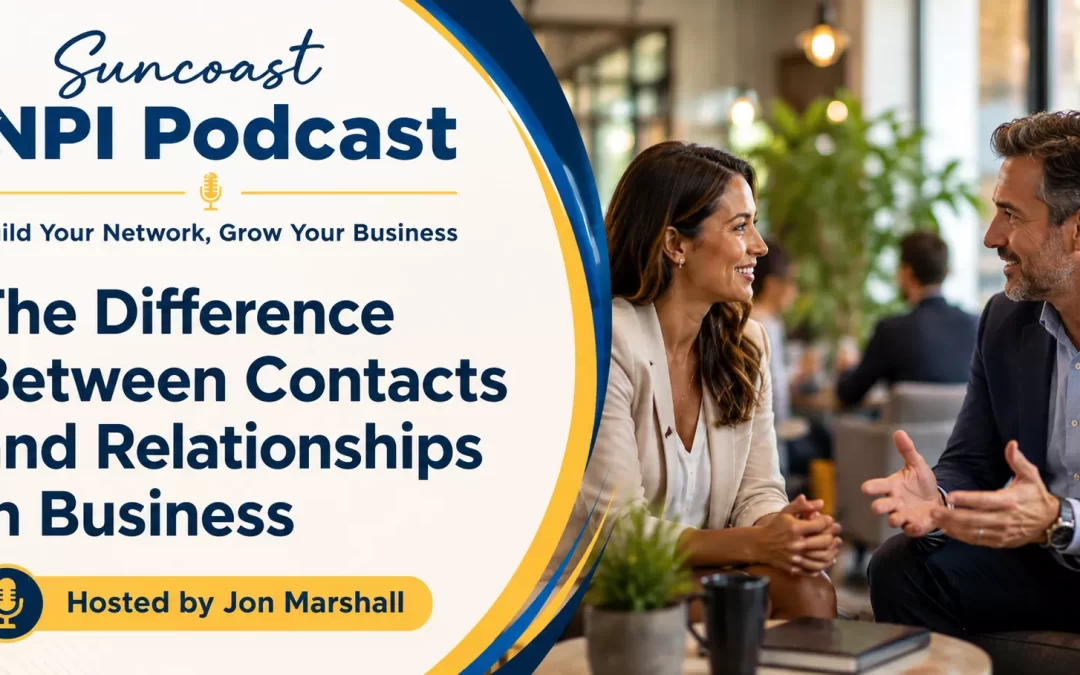
Hey everyone! Jon Marshall here, owner of Suncoast NPI. As our community in Hillsborough, Pasco, and Pinellas continues to grow, I see many business owners focusing on the wrong numbers. They spend their time collecting a massive list of names and phone numbers, thinking a thick stack of business cards equals a strong network. In reality, there is a fundamental difference between a contact and a relationship. One is just data on a screen; the other is the engine that drives a successful business.
A contact is someone you know of, or perhaps someone you met once at a local mixer in Clearwater. You have their email address, and they might know your name, but there is no depth to the connection. Relying on contacts forces you into a high-effort, low-reward cycle of constantly reaching out to people who have no real reason to trust you or help you. This approach is transactional and often leads to a lot of dead ends because the person on the other side has no skin in your game.
A relationship, on the other hand, is a professional bond built on mutual trust and a clear understanding of each other's goals. When you have a relationship with another professional, you know their character, their work ethic, and exactly who their ideal client is. Relationships turn a networking group into a team of advocates. A fellow member who understands your value will proactively look for ways to help you because they are invested in your success. These connections provide qualified referrals where the trust has already been established before you even talk to the prospect.
Building these relationships requires a commitment to the one-to-one meeting. These smaller, focused sessions are where you move past the "contact" phase. This is your time to learn about the specific challenges a fellow member faces and to show them how you can be a resource. In a professional networking group, the whole system depends on members looking for ways to help their fellow members first. By providing value to a marketing expert in Tampa or a plumber in Lutz, you earn the right to ask for their help in return. You are creating a reliable support system that ensures you have a group of peers who actually have your back.
Focusing on relationships changes your professional trajectory. It replaces the stress of cold calling with a steady stream of warm introductions from people who want to see you win. Five strong business relationships are worth more than five hundred random contacts in a database. These deep connections ensure your reputation is being shared throughout our local market by people who can personally vouch for your excellence and expertise.
Your success in our community is defined by the quality of these bonds. When you prioritize the depth of your connections over the size of your contact list, you create a sustainable way to grow your business. You move away from the "lone wolf" mentality and lean into a community that truly cares about supporting you and help you grow.
Until next time, this is Jon Marshall reminding you: when we pull together, we all win!