Podcast
Hey everyone! Jon Marshall here, owner of Suncoast NPI. As our business community across Tampa, Clearwater, and up into Pasco County experiences this incredible momentum, I hear a lot of people throwing around the word "referral." The problem is, many professionals use it when they are actually talking about a lead. There is a massive difference between the two, and understanding that difference determines whether your networking efforts produce real revenue or just a lot of wasted time. At Suncoast NPI, we focus exclusively on the gold standard: the qualified referral.
A qualified referral is an active introduction to a prospect who has a specific need, has given permission for you to contact them, and is already expecting your call. This is a complete contrast to a lead, which is simply a name, a phone number, or a piece of data you pulled off a website. A lead is cold, unverified, and usually comes with zero pre-established trust. When you chase a lead, you are starting from scratch, trying to convince a stranger to listen to your pitch.
A qualified referral bypasses that entire uphill battle. When a fellow member passes you a referral, they have already done the heavy lifting for you. They have identified a problem their client is facing, mentioned your specific expertise as the solution, and secured the client’s agreement to speak with you. This process means that by the time you make the first call, the prospect is already convinced of your value. The trust your fellow member spent years building with that client is instantly transferred to you.
This transfer of trust changes everything about the sales conversation. Instead of a defensive prospect wondering if you are going to rip them off, you get an open conversation with a person who wants your help. A residential roofer in Westchase or a CPA in Palm Harbor who works through qualified referrals closes a significantly higher percentage of business because the relationship begins on a foundation of mutual respect. This predictability turns your business development from a guessing game into a reliable system.
The whole system depends on members looking for ways to help their fellow members first. To receive these high-level introductions, you have to be actively listening for them on behalf of others. When you sit down for a one-to-one meeting with a mortgage broker in Carrollwood or a marketing expert in Largo, your goal is to learn the exact trigger phrases that indicate their ideal client is ready to buy. By training your mind to spot these opportunities, you become a source of qualified business for your team, which naturally causes them to look for opportunities for you.
Targeting the right geography ensures these introductions make sense for your business. When you communicate your boundaries clearly to your chapter, the referrals you receive match your service map perfectly. You avoid the noise of irrelevant names and focus entirely on high-quality connections that positively impact your bottom line.
Focusing on qualified referrals allows you to move away from the "lone wolf" mentality and lean into a community of peers who actually have your back. It replaces the stress of cold calling with direct access to motivated prospects. Aligning yourself with a group that shares your dedication to quality provides a reliable support system, putting your professional growth on an entirely new path.
Your reputation in our local market is built on the consistency of your actions and the quality of the help you offer. When you prioritize qualified referrals, you build a sustainable business based on local neighbor trust and genuine excellence.
Until next time, this is Jon Marshall reminding you: when we pull together, we all win!
Podcast
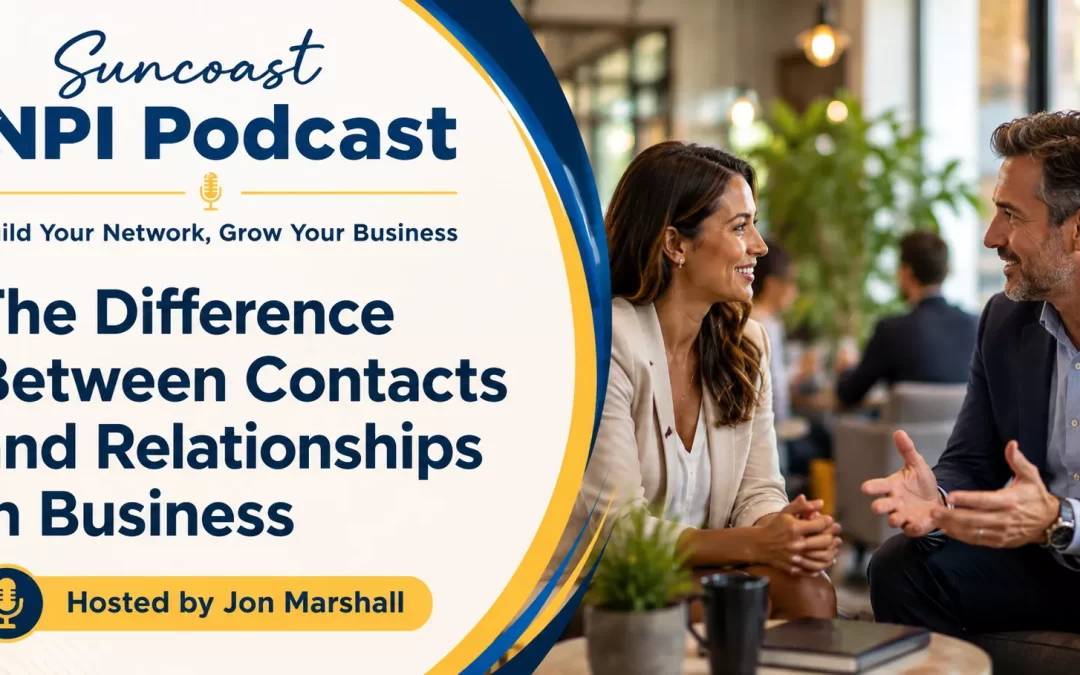
Hey everyone! Jon Marshall here, owner of Suncoast NPI. As our community in Hillsborough, Pasco, and Pinellas continues to grow, I see many business owners focusing on the wrong numbers. They spend their time collecting a massive list of names and phone numbers, thinking a thick stack of business cards equals a strong network. In reality, there is a fundamental difference between a contact and a relationship. One is just data on a screen; the other is the engine that drives a successful business.
A contact is someone you know of, or perhaps someone you met once at a local mixer in Clearwater. You have their email address, and they might know your name, but there is no depth to the connection. Relying on contacts forces you into a high-effort, low-reward cycle of constantly reaching out to people who have no real reason to trust you or help you. This approach is transactional and often leads to a lot of dead ends because the person on the other side has no skin in your game.
A relationship, on the other hand, is a professional bond built on mutual trust and a clear understanding of each other's goals. When you have a relationship with another professional, you know their character, their work ethic, and exactly who their ideal client is. Relationships turn a networking group into a team of advocates. A fellow member who understands your value will proactively look for ways to help you because they are invested in your success. These connections provide qualified referrals where the trust has already been established before you even talk to the prospect.
Building these relationships requires a commitment to the one-to-one meeting. These smaller, focused sessions are where you move past the "contact" phase. This is your time to learn about the specific challenges a fellow member faces and to show them how you can be a resource. In a professional networking group, the whole system depends on members looking for ways to help their fellow members first. By providing value to a marketing expert in Tampa or a plumber in Lutz, you earn the right to ask for their help in return. You are creating a reliable support system that ensures you have a group of peers who actually have your back.
Focusing on relationships changes your professional trajectory. It replaces the stress of cold calling with a steady stream of warm introductions from people who want to see you win. Five strong business relationships are worth more than five hundred random contacts in a database. These deep connections ensure your reputation is being shared throughout our local market by people who can personally vouch for your excellence and expertise.
Your success in our community is defined by the quality of these bonds. When you prioritize the depth of your connections over the size of your contact list, you create a sustainable way to grow your business. You move away from the "lone wolf" mentality and lean into a community that truly cares about supporting you and help you grow.
Until next time, this is Jon Marshall reminding you: when we pull together, we all win!

Podcast
Hey everyone! Jon Marshall here, owner of Suncoast NPI. One of the biggest hurdles business owners face while running a shop in Clearwater or managing a crew out in Wesley Chapel is simply knowing how to ask for help. We all know that word of mouth is the most powerful tool in our belt, but many professionals hesitate to ask for referrals because they do not want to seem pushy or desperate. In reality, your networking partners actually want to help you. They just need you to show them how.
The most common mistake I see is being too vague. When you tell a room full of professionals in Hillsborough or Pasco County that you are looking for "anyone who needs my services," you are actually making their job harder. "Anyone" is a ghost because nobody knows where to find "anyone." To get results, you have to be incredibly specific. Instead of a broad request, try describing a specific situation or a trigger event. For example, if you are a residential roofer, do not just ask for homeowners. Ask for people living in Trinity who have older homes and might be facing insurance cancellations. This specificity flips a switch in your partners' brains. Now, instead of scanning their entire contact list; they are thinking of that one neighbor or client who mentioned that exact problem yesterday.
It is also important to understand the massive gap between a lead and a qualified referral. A lead is just a name and a phone number, which is basically a cold call with a slightly better story. A qualified referral is a warm introduction where the potential client is already expecting your call and understands the value you provide. When you ask your partners for help, you should be coaching them on how to bridge that gap. Tell them exactly what to say when they encounter someone who needs you. Giving your partners the right language to use ensures the person is already convinced of your value before you even make the first call.
The whole system depends on members looking for ways to help their fellow members first. When you spend your time actively listening for opportunities to help a mortgage broker in Riverview or a landscaper in Palm Harbor, you build up a massive amount of professional capital. This makes asking for your own referrals feel much more natural. Plus, when you have consistently shown up for your fellow members, they become eager to return the favor. This proactive support creates a culture where asking for a referral is just a standard part of a productive business conversation.
Finally, make sure you are targeting the right geography. We are operating in an area that is evolving and expanding at an incredible pace right now, but your time is best spent on referrals that fit your service map. If your business stops at Ulmerton Road, make sure your partners in North Pinellas know that. Being clear about your boundaries helps your network filter out the noise and focus on the high quality connections that actually make sense for your bottom line.
By being specific, coaching your partners on the right language, and focusing on qualified introductions rather than just names, you turn your networking group into a precision tuned sales force. You will find that the more clear you are in your requests, the more your fellow members will deliver exactly what you need to grow.
Until next time, this is Jon Marshall reminding you: when we pull together, we all win!

Podcast
Hey everyone! Jon Marshall here, owner of Suncoast NPI. One of the most common misconceptions I hear while talking to business owners throughout Hillsborough, Pasco, and North Pinellas is the idea that you need to be a loud, high-energy extrovert to make networking work for you. Many people imagine that to succeed in a group, you have to be the life of the party or someone who can work a crowd at a local event like a seasoned politician. In reality, some of the most successful referral partners I’ve worked with are actually quite reserved. They find success because they understand that effective networking relies more on active listening and building genuine trust than on having the loudest voice in the room. Our local business community is seeing a level of momentum that most business owners only dream of, and there is more than enough room for every personality type to thrive.
Introverts often possess a secret weapon in a professional networking environment: the ability to listen deeply. While a more talkative person might be busy sharing their own story, a quieter professional is often the one picking up on the subtle details that turn a casual conversation into a qualified referral. When you are sitting across from a partner at a local café in Dunedin or a quiet office in Tarpon Springs, your goal is to understand their business challenges and identify their ideal client. Because introverts tend to be observant, they are often better at identifying the specific "trigger phrases" that indicate a friend or client needs a professional service. This makes them incredible referral partners because they provide warm, thoughtful introductions that lead to real business results.
A structured environment provides a massive advantage for those who might feel a bit nervous in social settings. At Suncoast NPI, we provide a consistent framework for every meeting, which takes the pressure off having to perform or come up with conversation on the fly. You know exactly when it is your turn to speak and exactly what information your partners need to hear. This predictability allows you to focus on your message rather than worrying about the social dynamics of the room. Furthermore, the real work of networking happens during one-to-one meetings outside of the main chapter sessions. These smaller, more personal interactions are perfect for anyone who prefers deep, focused conversation over small talk. Building a strong referral network consists of a series of individual relationships built over time, which suits a more measured personality perfectly.
Choosing to join a group also changes the way you approach business development. Instead of the high-stress grind of chasing cold leads—which often feels like an uphill battle for anyone who isn't a natural-born salesperson—you are working within a system of warm introductions. A qualified referral from a trusted partner means the potential client already knows who you are and respects your work. This makes the initial conversation much easier because the trust has already been established for you. You don't have to be "on" all the time; you just have to be yourself and be reliable. The whole system depends on members looking for ways to help their partners first, and that is a mindset that anyone can adopt regardless of where they fall on the introvert-extrovert spectrum.
Your ability to provide value to others defines your success in our community. Whether you are a quiet professional working in Largo or a high-energy entrepreneur in the heart of Tampa, your reputation is built on the consistency of your actions and the quality of the help you offer. People refer business to those they trust, and trust is earned through follow-through and genuine care. If you can show up, listen, and look for ways to support your peers, you will find that a professional networking group is an incredibly effective tool.
Until next time, this is Jon Marshall reminding you: when we pull together, we all win!

Podcast
How Do I Know If a Networking Group Is Right for Me?
Hey everyone! Jon Marshall here, owner of Suncoast NPI. As our community continues to see a level of momentum that most business owners only dream of, I’m often approached by professionals who feel like they are at a crossroads. They know they need to grow, and they’ve heard that word-of-mouth is the gold standard for high-quality referrals, but they aren't quite sure if joining a structured networking group is the right move for their specific business or personality. It is a vital question because your time is your most limited resource. Deciding to join a group shouldn't feel like a shot in the dark. It should be a calculated decision based on your goals, your capacity to give, and the stage of your business. Joining a group with the wrong fit can feel like a frustrating waste of time. But, joining the right group can fundamentally change how you do business and put your professional growth on an entirely new path.
The first way to determine if this path is right for you is to look at your current sales process. If your business thrives on trust and high-level service, such as a residential contractor or CPA, then you are likely in a prime position to benefit from a referral-focused environment. These are industries where a cold lead from the internet often lacks the "pre-sold" confidence that a personal recommendation provides. If you find that you close a much higher percentage of clients when they are introduced by a mutual friend, then a networking group is essentially a way to systematize that success. However, you also have to consider your capacity for consistency. A group like Suncoast NPI isn't a "drop-in" social club. It’s a commitment to a team. If you are in a season of business where you can’t commit to showing up for others, it might not be the right time. But if you are ready to be a reliable partner, the structure will act as a force multiplier for your efforts.
Another key indicator is your appetite for collaboration over competition. One of the greatest benefits of a seat-specific group is the lack of internal rivalry. If you are the type of person who enjoys sharing knowledge and brainstorming with other professionals who are also navigating the local market, you will likely thrive in this environment. You have to ask yourself if you are willing to spend as much time looking for opportunities for your partners as you spend looking for them for yourself. The whole system depends on members looking for ways to help their fellow members first. If the idea of being an advocate for a roofer in Largo or a marketing expert in Tampa sounds rewarding to you, then you have the right DNA for a professional networking group. Finally, you should evaluate the physical and professional "vibe" of the group by visiting a few sessions. Every chapter has its own personality, and the only way to know if you fit is to get in the room. Pay attention to how the members interact. Are they genuinely interested in each other's success? Is there a sense of professional energy and mutual respect? You want to be in a room that challenges you to be better and holds you to a higher standard of excellence. If you walk out of a meeting feeling energized and supported, that’s a strong sign you’ve found your tribe. Ultimately, the right group will feel like a natural extension of your brand. It should

Podcast
Hey everyone! Jon Marshall here, owner of Suncoast NPI, and today I want to tackle a
question that I hear quite often while I’m out and about meeting with entrepreneurs from
Clearwater over to Brandon. Business owners are constantly bombarded with options
on where to spend their marketing dollars, from social media ads to local sponsorships,
and many wonder if paying for a seat at a networking table is truly a smart investment.
The reason this question is so vital is that time and money are the two most precious
resources you have as a leader. When you consider a networking membership, you are
looking at more than just a line item on a budget. You are evaluating the long-term
growth potential of your professional reputation. A high-quality membership provides a
level of filtered access to the local marketplace that you simply cannot get by attending
random mixers or handing out flyers at a community event. It offers a structured path to
visibility and credibility that acts as a shortcut to building a sustainable business in our
fast-paced Tampa Bay economy.
The value of a networking membership becomes clear when you look at the immediate
access it provides to a vetted circle of professionals. When you join a group like
Suncoast NPI, you are stepping into a room full of local experts who have already been
through a screening process. This means you aren't starting from scratch. You are
leveraging the collective trust of the group. If you were to try and build fifty individual
relationships of that caliber on your own, it would take months, if not years, of cold
calling and awkward coffee dates. By paying for a membership, you are essentially
purchasing a seat in an established ecosystem where the culture of referring business
is already the standard. This saved time is often the most significant return on
investment because it allows you to focus on your core business operations while your
partners are actively looking for opportunities to send your way. It turns your marketing
efforts from a series of disjointed acts into a cohesive strategy backed by a team of
advocates.
Another factor to consider when weighing the worth of a membership is the professional
development and accountability that comes with it. Being part of a structured group
forces you to sharpen your message and become a better communicator. Every time
you stand up to describe your business to a room of professionals in Clearwater or
Tampa, you are refining your pitch and gaining confidence. This regular practice
ensures that you stay sharp and stay focused on your goals. Furthermore, the
accountability of a membership keeps you consistent. It is easy to let marketing slide
when you get busy, but a membership ensures you are showing up and staying top-of-
mind with the people who can help you grow. This consistency is what builds the "know,
like, and trust" factor that is required for high-ticket referrals. When your fellow members
see you every week, they witness your dedication and professional growth, which
makes them much more likely to put their own reputation on the line by recommending
you to their best clients.
Finally, the worth of a networking membership should be measured by the quality of the
business it generates. Referrals born out of a professional group are typically pre-
qualified and come with a much higher closing ratio than leads from other sources.
Because the person referring you has already done the heavy lifting of building trust, the
sales process is shorter and more pleasant. When you calculate the lifetime value of
just one or two high-quality clients gained through a referral, it often covers the cost of a
yearly membership many times over. Beyond the dollars and cents, there is the
intangible value of the support system you gain. Having a group of peers to lean on for
advice or to celebrate wins with is an asset that is hard to put a price tag on but is
essential for long-term success. Investing in a membership is an investment in your
local community and your own professional future, ensuring you are never building your
business in a vacuum.
Until next time, this is Jon Marshall